
Co-developing a program-specific exam wrapper with faculty can create a cohesive, contextually relevant approach to supporting learner metacognitive skill development and may facilitate integration into existing educational practices. When used to guide post-exam conversations, exam wrappers can reduce grade-focused discussions and help faculty and learners focus on study strategies, reflection, and future improvement.
ABSTRACT
Introduction: Post-exam review sessions in health professions education often emphasize performance outcomes rather than how students prepared or how they can improve.
Description of Innovation: To address this gap, led by educational developers, faculty collaboratively reviewed existing exam wrappers, identified and adapted questions relevant to the program’s curriculum and learner needs, and co-developed a program specific tool addressing preparation, study strategies, exam performance, and future planning. Faculty used the tool to guide post-exam meetings with students.
Results: Four anonymous faculty respondents reported using the exam wrapper, and all four rated it as very helpful and indicated that they would continue its use. Faculty reported that the tool shifted conversations toward analysis of study approaches, identification of learning gaps, and development of actionable plans, resulting in more focused and efficient interactions.
Conclusions: These findings provide a practical approach to supporting student study skills, with example exam wrapper questions and implementation prompts that other programs can adapt to develop program-specific exam wrappers.
INTRODUCTION
Health professions education programs are academically rigorous and require learners to adapt their study strategies to meet high expectations and complex cognitive demands (Dunlosky et al., 2013). Within these environments, some learners experience academic difficulty, particularly when prior learning strategies are insufficient for new types of assessment or levels of application and integration (Hauer et al., 2009). Faculty are often called upon to meet with learners following poor exam performance; however, these interactions are frequently unstructured and may focus on performance outcomes rather than underlying learning processes (Stanton et al., 2021). Without structured approaches, post-exam discussions may not consistently promote meaningful reflection or behavior change.
Metacognition is defined as the ability to monitor, evaluate, and regulate one’s own thinking (Flavell, 1979). It is a critical component of effective learning and academic success (Stanton et al., 2021). Metacognitive processes are central to self-regulated learning, which includes planning, strategy selection, monitoring performance, and adapting approaches based on feedback (Zimmerman, 2002). These processes are particularly important in rigorous educational settings where learners must independently adjust their learning strategies over time.
Educational strategies that explicitly scaffold metacognition can support learners in developing more effective and adaptive approaches to studying. Exam wrappers are one such strategy: structured reflection tools completed after an assessment that prompt learners to evaluate their preparation, analyze their performance, and plan changes for future assessments (Pate et al., 2019). Prior research has demonstrated that exam wrappers can increase metacognitive awareness, encourage the use of more effective study strategies, and promote a shift from grade-focused to process-oriented learning (Pate et al., 2019). These tools are also valued for their feasibility and adaptability across a range of educational contexts (Sethares & Asselin, 2022).
Despite their use across disciplines, many existing exam wrappers are designed as general tools or used only by individual faculty and may not align with the specific curricular structures, assessment practices, and learner needs of individual programs. In specialized and cohort-based programs, there is potential value in developing program-specific tools that reflect local expectations and integrate into existing teaching and advising practices. Engaging faculty in the development and implementation of such tools may strengthen contextual relevance and support integration into existing practices.
To address these needs, we co-developed a program-specific exam wrapper through a facilitated learning community within a health professions program in the School of Medicine. This approach engaged faculty in the co-creation of a tailored tool while supporting shared understanding of metacognitive principles and strategies for assisting struggling learners. In this paper, we describe the development of a program-specific exam wrapper, as well as faculty perspectives on its use to enhance post-exam reflection and support more effective, learner-centered conversations.
DESCRIPTION OF INNOVATION
The program-specific exam wrapper was developed in Spring 2025 through a facilitated learning community in the Emory University School of Medicine Anesthesiologist Assistant (AA) Program, a 27-month curriculum enrolling 45 students per cohort. The facilitated learning community brings approximately nine AA faculty members together with educational developers for recurring faculty development focused on program-specific teaching and assessment needs identified by faculty. Participating faculty teach and assess students across the AA curriculum. Limited implementation of the exam wrapper began in Summer 2025, followed by broader rollout in Fall 2025/Spring 2026.
Faculty reviewed several exam wrapper examples, including an unpublished exam wrapper previously developed by one of the authors (K.J.W) and publicly available examples from Carnegie Mellon University (physics and biology), Duke University, and Virginia Tech (Carnegie Mellon University Eberly Center, n.d.; Duke Center for Teaching and Learning, 2016; Virginia Tech Center for Excellence in Teaching and Learning, n.d.). Faculty compared common features across the examples and considered how each would apply within the AA curriculum. They converged on the need for a concise tool that addressed preparation time, study strategies, barriers, patterns in exam performance, and future planning. The group developed and adapted example questions within several categories to inform the final wrapper (Table 1).
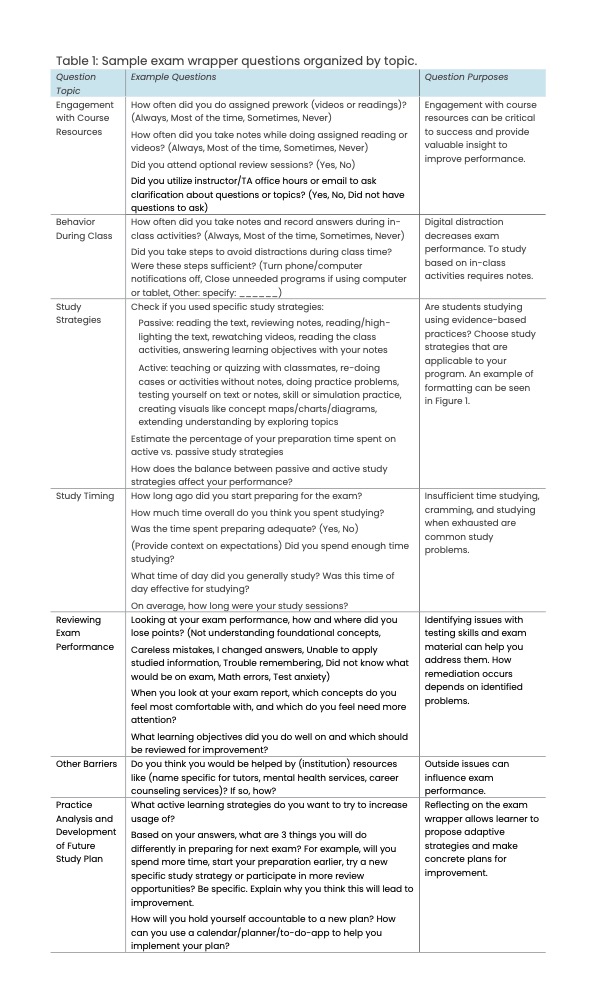
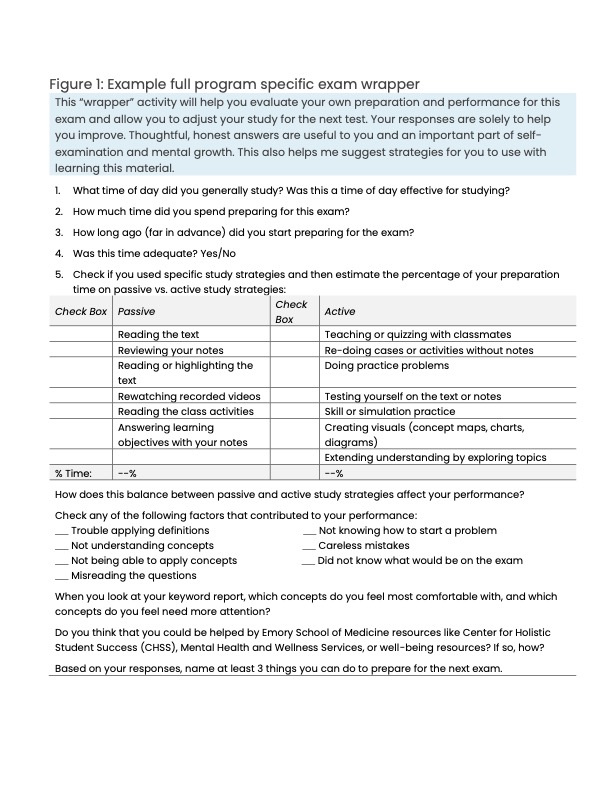
The group also developed questions prompting learners to reflect on passive and active study strategies and adapted an introductory purpose statement. Educators then selected and tailored questions from the identified categories to create the program-specific exam wrapper (Figure 1), which included questions about study time, study strategies, barriers to studying, exam performance, and plans for improvement. After developing the draft, facilitators led a discussion on how and when to use the exam wrapper. The facilitators had educators discuss:
- At which point in curriculum (or within a course) would you want to utilize an exam wrapper?
- When/how do you want students to explore metacognition? At the beginning of the semester? While doing the exam wrapper? Both?
- How would you incentivize the completion of the exam wrapper? Would it be worth points towards a grade or just an in-class activity?
- Would you like to receive or provide feedback on study plans or goals?
These deliberations led to the decision to use the exam wrapper as a pre-activity before learner consultation with faculty about exam performance. This was to address the problem of exam litigation and focus instead on the process of learning and what they could do to improve.
RESULTS
To understand the impact of the exam wrapper, we conducted an anonymous survey of AA educators, most of whom participated in the facilitated learning community in which the exam wrapper was developed. At the time of the evaluation, four anonymous faculty survey respondents reported they had used the exam wrapper, and one additional respondent reported plans to use it. This work was reviewed by the Institutional Review Board (IRB ID: STUDY00009382) and determined to constitute program evaluation rather than human subject research.
The first survey question used a Likert scale to rate how helpful different resources created as part of the learning community were. All four respondents who reported using the exam wrapper rated it as very helpful. Next, we contextualized this information with the question: What evidence (formal or informal) made you feel the exam wrapper was, or was not, effective in your course? Faculty reported that the exam wrapper had been helpful for them by refocusing their time with students from exam litigation to areas of improvement and study strategy:
“I require the students to fill out the exam wrapper prior to meeting with me. It allows for much more self-reflection during our discussion, rather than focusing on the perceived unfairness of each question.”
“I was able to compare studying methods between high performers and lower performing students. I could then give advice to students about what techniques were most successful in my course.”
“Effective because it encouraged students to really think about their approach to an exam and allowed me to see where areas of improvement could be. Instead of ‘tell me the answers I missed’, it became more of a topical conversation piece to guide our discussions.”
Next, we asked faculty: ‘How likely are you to continue using the exam wrapper in future courses, and why or why not?’ All four respondents who reported using the exam wrapper indicated they will continue using the exam wrapper based on its value around reflection/action planning, and the potential to improve study skills and grades. One additional respondent reported they planned to use it in the future. The anonymous survey did not allow us to determine whether the four respondents who reported using the exam wrapper were among the educators who had participated in its co-development.
DISCUSSION
This innovation demonstrates how a program-specific exam wrapper can support more structured and learner-centered post-exam conversations. Faculty perceived the tool as shifting discussions away from individual test items and toward reflection on study strategies, preparation, and opportunities for improvement. These findings align with prior literature suggesting that structured reflection tools can promote metacognitive awareness and support more productive feedback conversations (Pate et al., 2019).
A key contribution of this work is the emphasis on program-specific adaptation. While exam wrappers are widely described in the literature, their implementation is often left to individual instructors. By engaging faculty collectively in the co-construction process, this approach allowed educators to align the tool with shared curricular expectations, assessment practices, and terminology. This co-development may have strengthened the contextual relevance of the tool; however, the anonymous evaluation did not allow for the determination of whether participation in development influences subsequent adoption or whether faculty outside the learning community used the tool. Nonetheless, faculty who used the tool perceived it as useful and indicated willingness to continue using it. Additionally, the learning community structure provided space for faculty to discuss not only the content of the exam wrapper, but also how and when it should be implemented, which is critical for meaningful integration into existing workflows.
For other programs seeking to implement similar tools, several practical considerations emerged from this work. First, exam wrappers should be concise to encourage completion and usability; limiting the tool to one page when possible may reduce cognitive burden. Second, questions should prioritize key domains that support metacognitive reflection, including study time, study strategies, barriers to learning, and development of a future study plan. Third, adapting language and examples to reflect local program structures and expectations can increase relevance for learners. Finally, programs should intentionally determine how exam wrappers will be used (e.g., as a pre-meeting activity, in-class reflection, or graded assignment) to ensure alignment with instructional goals and avoid perceptions of unnecessary workload. Programs seeking to implement similar tools may use the consolidated questions in Table 1 as a starting point, either as presented or adapted to their local context.
There are limitations to this study. First, findings are based on a small number of faculty within a single program, which may limit generalizability. Second, the evaluation focused on faculty perceptions of usefulness rather than direct measures of student outcomes, such as changes in study behaviors or academic performance. Third, this work represents an early phase of implementation, and longer-term use may yield different insights regarding sustainability and impact. Finally, because the faculty survey was anonymous, we could not link reported use to participation in the co-development session, determine whether faculty outside the learning community adopted the wrapper, or calculate program-wide adoption rate.
Despite these limitations, this work highlights the potential for scaling program-specific metacognitive tools across educational contexts. The facilitated learning community model may be particularly useful for other programs seeking to implement educational innovations that require both faculty engagement and contextual adaptation. Based on follow-up discussion with AA program leadership, a program-wide roll-out is planned for Fall 2026. As this roll-out is planned, actual use outcomes from broader implementation are not yet available.
Future work could examine actual use across faculty, faculty perception of exam wrapper-guided meetings with learners, student perspectives, reported changes in behaviors (i.e. study strategies, goal setting, self-regulated/directed learning), and the impact of exam wrappers on academic outcomes. Additionally, similar approaches could be extended beyond written examinations to other forms of assessment, such as simulation or clinical performance, where structured reflection may also enhance learning.
CONCLUSION
A program-specific exam wrapper represents a feasible and faculty-informed approach to supporting learner reflection and metacognitive skill development in a health professions program. Developed through a collaborative process with faculty, this tool was designed to be contextually relevant and integrated into existing educational practices. Early findings suggest that the exam wrapper helped shift post-exam conversations toward reflection, strategy use, and future planning, contributing to more productive and learner-centered interactions.
This work highlights the importance of pairing evidence-based educational strategies, such as exam wrappers, with intentional implementation approaches that account for local context and faculty engagement. As health professions programs continue to seek ways to support learners experiencing academic difficulty, program-specific metacognitive tools offer a practical and scalable approach. Future efforts should focus on evaluating student outcomes, exploring broader implementation across programs, and examining how similar strategies can be applied across different types of assessments.
ACKNOWLEDGMENTS
The authors would like to thank the Emory University School of Medicine Anesthesiologist Assistant Program faculty who participated in the facilitated learning communities and contributed to the development and implementation of the program-specific exam wrapper. We also thank Katherine Monroe, PhD, MMSc, CAA, Program Director of the Emory Anesthesiologist Assistant Program, for her support of this work.
The authors received no grant support for this work and declare they have no conflicts of interest in regard to this work.
Carnegie Mellon University Eberly Center. (n.d.). Exam wrappers. Carnegie Mellon University. https://www.cmu.edu/teaching/designteach/teach/examwrappers/
Duke Center for Teaching and Learning. (2016, September 26). Exam wrappers to help students learn. https://ctl.duke.edu/blog/2016/09/exam-wrappers-to-help-students-learn/
Dunlosky, J., Rawson, K. A., Marsh, E. J., Nathan, M. J., & Willingham, D. T. (2013). Improving students’ learning with effective learning techniques: Promising directions from cognitive and educational psychology. Psychological Science in the Public Interest, 14(1), 4–58. https://doi.org/10.1177/1529100612453266
Flavell, J. H. (1979). Metacognition and cognitive monitoring: A new area of cognitive-developmental inquiry. American Psychologist, 34(10), 906–911. https://doi.org/10.1037/0003-066X.34.10.906
Hauer, K. E., Ciccone, A., Henzel, T. R., Katsufrakis, P. J., Miller, S. H., Norcross, W. A., Papadakis, M. A., & Irby, D. M. (2009). Remediation of the deficiencies of physicians across the continuum from medical school to practice: A thematic review of the literature. Academic Medicine, 84(12), 1822–1832. https://doi.org/10.1097/ACM.0b013e3181bf3170
Pate, A., Lafitte, E., Ramachandran, S., & Caldwell, D. (2019). The use of exam wrappers to promote metacognition. Currents in Pharmacy Teaching and Learning, 11(5), 492–498. https://doi.org/10.1016/j.cptl.2019.02.008
Sethares, K. A., & Asselin, M. E. (2022). Use of exam wrapper metacognitive strategy to promote student self-assessment of learning: An integrative review. Nurse Educator, 47(1), 37–41. https://doi.org/10.1097/NNE.0000000000001026
Stanton, J. D., Sebesta, A. J., & Dunlosky, J. (2021). Fostering metacognition to support student learning and performance. CBE—Life Sciences Education, 20(2), fe3. https://doi.org/10.1187/cbe.20-12-0289
Virginia Tech Center for Excellence in Teaching and Learning. (n.d.). Exam wrappers and test analyses. Virginia Tech. https://teaching.vt.edu/teachingresources/adjustinginstruction/exam-wrappers-and-test-analyses.html
Zimmerman, B. J. (2002). Becoming a self-regulated learner: An overview. Theory Into Practice, 41(2), 64–70. https://doi.org/10.1207/s15430421tip4102_2
Nikita E. Chavarria, PhD
Senior Educational Developer, Assessment, Program Evaluation, and Continuous Quality Improvement Unit, Emory University School of Medicine
Kristy J. Wilson
Educational Developer, Assessment, Program Evaluation, and Continuous Quality Improvement Unit, Emory University School of Medicine
Published 10/8/26