
Team-based public health case competitions are a feasible, motivating way to engage high school students in health equity challenges and increase participation in capstone projects in pipeline programs.
INTRODUCTION
Many students, especially those from historically underrepresented racial and ethnic groups, lack early exposure to public health education (Institute of Medicine, 2003; Vichare et al., 2023). In the context of the persistent lack of diversity in health professions, this limited exposure is alarming and has led some to suggest that increased early exposure may be a strategy to advance health equity (Vichare et al., 2023). Especially compared to nursing or medical disciplines, public health is rarely included in high school curricula (D’Agostino, 2018). Pipeline programs that combine academic support, mentoring, and early health career exposure are a strategy to increase diversity in health-related fields (Boekeloo et al., 2017).
The Emory Pipeline Collaborative (EPiC) is one such program. It is a longitudinal Health Resources and Services Administration (HRSA)-supported program that promotes academic achievement, college readiness, mentorship, health career awareness, and self-efficacy among educationally or economically underserved students (Emory University School of Medicine, 2026). Students are recruited from Atlanta public high schools during their sophomore year and selected based on academic performance, interest in health careers, and commitment to after‑school programming. Each cohort includes approximately 25 students who progress through a three-year program, of which the final year is focused on public health. While overall program completion is typically >90%, the 2024 senior cohort had an uncharacteristically low completion rate, with 26% failing to complete EPiC. This decrease was not mirrored in the sophomore or junior cohorts during 2024, and informal conversations with graduate mentors highlighted limited engagement with the individual capstone project in the 2024 senior cohort, which may have contributed to students not completing the program. We sought ways to redesign the capstone project to increase student engagement while they explored public health issues.
Project‑based learning that emphasizes collaborative, real‑world problem solving has been associated with improved academic outcomes and higher‑order thinking compared with traditional instruction (Zhang & Ma, 2023). In high school health curricula, models such as Project Health have increased student engagement with urban health issues, supporting interactive team‑based case projects as a strategy to strengthen public health understanding among secondary school students (Zusevics et al., 2013). Based on this, curriculum coordinators redesigned the senior capstone as a team‑based public health case competition for the 2025 senior cohort. This pilot examined whether the redesigned case‑competition capstone improved senior engagement with the capstone, increased program completion, and enhanced self‑reported teamwork, research skills, and public health understanding compared to the prior individual capstone model.
METHODS
Program Overview
Each EPiC cohort is organized into five “societies” named after prominent physicians, such as the Semmelweis society, which is named after Ignaz Semmelweis. Students remain in the same society across all three years of programming. In addition to the four to five high school students and their individually paired undergraduate mentor, each society includes two to three graduate mentors from graduate health-related programs at Emory University. During the spring semester, students attend two hours of weekly after-school programming for ten weeks at the Emory University School of Medicine campus. The sophomore cohort focuses on reproductive health, the junior cohort on neurology and mental health, and the senior cohort on public health, with topics selected for relevance and alignment with multiple health career paths. Throughout the spring session, the senior cohort receives ten prepared lessons covering the history of public health, epidemiology, infectious diseases, research, emergency response, and related topics. Graduate mentors deliver this content to their assigned society and oversee undergraduate mentorship. At the end of each spring semester, students complete a final project related to that year’s curriculum; prior to 2025, seniors completed an individual literature review and presentation.
Capstone Case Competition
Intervention – Curriculum coordinators conducted a literature review with the assistance of a large-language model (GPT-4o) to identify major public health issues. Five topics were chosen for relevance to high school students. For each topic, a mock case was developed describing the background of a patient and outlining social, economic, and environmental factors affecting care. Topics included “Air Quality Impact on Asthma in California”, “Malaria Prevention in Nigeria”, “Vaccination Gaps in Rural India”, “Access to Diabetes Care in Texas”, and “Mental Health Access for Native Communities in Alaska” (Appendix A). Each society was randomly assigned one case to ensure exposure to diverse public health challenges. Teams developed interventions for their assigned case, culminating with a 15-minute presentation. They were asked to present recommendations addressing environmental, epidemiological, and socioeconomic implications, including budget, actionable goals, and limitations.
Students were provided weekly guiding questions based on lecture topics and collaborated with mentors to brainstorm interventions. Students were also provided with a judging template focused on seven criteria: holistic approach, involvement of community partners, innovation, ethical/cultural/community considerations, budget, and delivery of presentation. Each group was judged by two curriculum coordinators using a standard rubric and provided with constructive feedback (Appendix B). This redesigned capstone project replaced the prior individual literature review assignment for the 2025 senior cohort, while other program components (cohort structure, weekly didactic sessions, mentorship) remained unchanged.
Evaluation Methods – To measure the success of the new capstone model, curriculum coordinators solicited informal feedback from student participants and mentors through brief end‑of‑session conversations. Participation in these conversations was voluntary, and coordinators summarized recurring themes related to engagement, perceived difficulty, skill development, and interest in public health. Quantitative outcomes included program completion rates, pre-survey data collected prior to the 2025 public health curriculum, and end-of-year post-survey data from the 2024 and 2025 senior cohorts. In the inaugural year of the capstone public health case competition, the senior Semmelweis society achieved the highest capstone presentation score. We selected the Semmelweis society for subgroup analysis to examine changes in skills and confidence among students who were most engaged with the redesigned capstone. This subgroup analysis aimed to generate hypotheses about potential mechanisms of impact and does not imply that other societies failed to benefit. For this subgroup and for the 2025 senior cohort as a whole, we calculated mean pre-survey scores, post-survey scores, and percent change.
Survey items assessed self‑reported teamwork, research skills, public speaking confidence, public health understanding, and interest in health‑related careers. Survey items were administered using Likert scales of either 1-5 or 1-10; responses on the 1-5 scale were rescaled to 1-10 to facilitate comparison. A “1” on the scale indicated very low confidence or understanding, and 10 indicated very high confidence or understanding. The pre-survey was administered prior to the start of the class of 2025’s public health curriculum, and the post-survey after capstone presentations concluded. The class of 2024’s survey was administered at the end of the program. Pre‑ and post‑survey responses from the class of 2025 were matched using students’ school email addresses by EPiC staff.
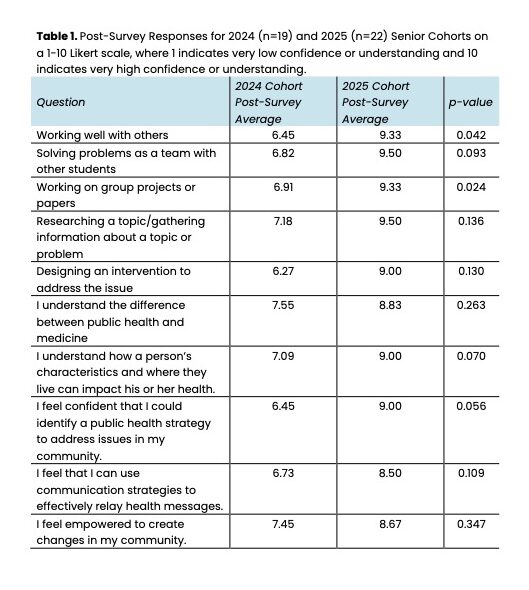
After pairing, personal identifiers were removed and replaced with unique codes. Post-survey comparisons were conducted using Microsoft Excel; other statistical analysis was performed in R (version 4.5.3). Between-cohort comparisons of post-survey scores (Table 1) were performed using a two-sided Wilcoxon rank-sum test.
This work was conducted as part of routine program evaluation for EPiC and did not require review by the Emory University Institutional Review Board, in accordance with institutional guidance on quality improvement and program evaluation activities. Student survey data were analyzed in a coded dataset without direct identifiers, and participation in the surveys was voluntary.
RESULTS AND DISCUSSION
All societies successfully created a capstone presentation. Across societies, higher marks were awarded for innovation, ethical/cultural/community concerns, and holistic nature of solutions compared to budget or community partner identification. This was expected given the lack of emphasis in the curriculum on these topics. Informal feedback from students and mentors highlighted increased engagement, enthusiasm for public health, confidence in collaborative problem-solving, and interest in pursuing health-related careers, compared to the 2024 senior cohort. Graduate mentors initially worried that the capstone would be too challenging for high school students, but upon completion, mentors noted that students’ solutions were often more creative and insightful than expected.
Incomplete or unpaired responses from the surveys were excluded, yielding a final sample size of n = 19 (79% survey completion) for the 2024 senior cohort, n = 22 (88% survey completion) for the 2025 senior cohort, and n = 4 (80% survey completion) for the 2025 Semmelweis subgroup. On the post-survey, the 2025 senior cohort demonstrated higher average scores than the 2024 cohort across measures of confidence in teamwork skills, research competencies, and public health understanding, with improvements of approximately 2-3 points across 11 metrics (Table 1). Several differences between cohorts were statistically significant, including “working well with others” (p=0.042) and “working on group projects or papers” (p=0.024), whereas others did not reach statistical significance, likely reflecting the small sample size and limited power. Taken together with the qualitative feedback, these findings provide preliminary evidence that the enhanced EPiC model may have strengthened interdisciplinary skills among high school seniors from educationally and economically underserved Atlanta communities. These findings should be interpreted cautiously and confirmed in a larger, adequately powered sample.
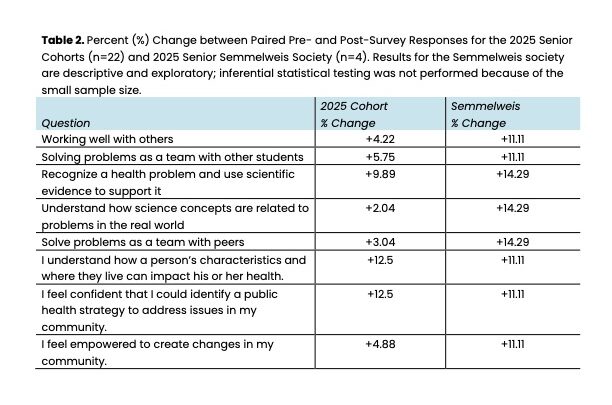
For the 2025 Semmelweis society, which received the highest ratings on our judging rubric, we analyzed pre-post data to assess gains associated with participation. This society showed ~11% improvement in teamwork and community-oriented public health skills and ~14% increase in applied science skills (Table 2). Given the small subgroup size (n=4), these results are presented descriptively without inferential statistical testing and should be interpreted as exploratory.
Following the implementation of the case-competition model in the 2025 senior cohort, program completion reached 100% (compared to 74% for the class of 2024). Objective and subjective data suggest that increasing the challenge of the final project and switching to a collaborative team format increased students’ engagement and motivation.
CONCLUSIONS
This pilot supports case competitions as a scalable strategy to strengthen engagement, problem-solving, and public health interest among educationally or economically underserved high school students. Future interventions should explore broader implementation of the case-competition model in secondary schools.
ACKNOWLEDGMENTS
The authors thank the graduate mentors for their support in implementing the senior capstone redesign; the undergraduate mentors for their continued guidance and mentorship; Ms. Annie Butler for coordinating the pipeline program; the teacher liaisons for facilitating student participation and supervision; and the student participants for their enthusiasm, engagement, and willingness to explore public health challenges through this program.
EPiC is primarily supported by funding from the Health Resources and Services Administration (HRSA), with additional support from the McKesson Foundation, Boston Scientific, and the Emory University School of Medicine.
The authors declare that they have no conflicts of interest related to this work and received no payment or third‑party services for the preparation of this manuscript.
Boekeloo, B. O., Todaro Brooks, A., & Wang, M. Q. (2017). Exposures associated with minority high schoolers’ predisposition for health science. American Journal of Health Behavior, 41(2), 104–113. https://doi.org/10.5993/AJHB.41.2.1
D’Agostino, E. (2018). Public health education: Teaching epidemiology in high school classrooms. American Journal of Public Health, 108(3), 324–328. https://doi.org/10.2105/AJPH.2017.304216
Emory University School of Medicine. (2026). Emory Pipeline Collaborative (EPiC). https://med.emory.edu/education/outreach-recruitment/epic/
Institute of Medicine (US) Committee on Educating Public Health Professionals for the 21st Century. (2004). Who will keep the public healthy? Educating public health professionals for the 21st century. National Academies Press. https://doi.org/10.5860/CHOICE.41-2850
Vichare, A., Park, Y. H., & Plepys, C. M. (2023). Diversity of the U.S. public health workforce pipeline (2016–2020): Role of academic institutions. American Journal of Public Health, 113(9), 1000–1008. https://doi.org/10.2105/AJPH.2023.307352
Zhang, L., & Ma, Y. (2023). A study of the impact of project-based learning on student learning effects: A meta-analysis study. Frontiers in Psychology, 14, Article 1202728. https://doi.org/10.3389/fpsyg.2023.1202728
Zusevics, K. L., Lemke, M. A., Harley, A. E., & Florsheim, P. (2013). Project Health: Evaluation of a project-based health education program. Health Education, 113(3), 232–253. https://doi.org/10.1108/09654281311309855
Ramya Ginjupalli, BS
Medical Student, Emory University School of Medicine
Megan McCorkle, DPT, MS
Emory University School of Medicine
Allen Lee, MAT
Director, Outreach and Recruitment Programs, Office of Enrollment Management, Emory University School of Medicine
Published 10/16/26