
Personal statement workshops can improve pre-health students’ confidence and preparedness in translating their experiences, motivations, and identities into effective application narratives, thereby reducing hidden curriculum barriers and better supporting first generation and low-income applicants to health professions programs.
ABSTRACT
Introduction: In the wake of the 2024 ruling to abolish affirmative action, Black/African American and Hispanic medical school matriculants declined by 11.6% and 10.8%, respectively, raising concerns about the future of diversity in medicine. The personal statement allows graduate and health professional applicants to incorporate unique aspects of their identities to demonstrate preparedness for careers in healthcare.
Innovation: The Personal Statement Workshop, part of Emory’s Health Professions Readiness Education Program (HealthPREP), provided a structured approach to crafting statements that effectively demonstrate students’ unique experiences, perspectives, and strengths beyond standardized test scores.
Study/Results: Pre- and post-workshop were used to assess changes in confidence and ability; paired t-tests were used to analyze the results. Students reported an increase in their ability to understand how the personal statement should be formatted according to their program of choice (p<0.001), an increase in their confidence to describe the purpose of the personal statement (p<0.05), and increased confidence in their ability to write a personal statement for their program of choice (p<0.001).
Conclusions: Our workshop demonstrated that a structured approach to writing the personal statement significantly improved students’ confidence in their ability to share their identities and experiences in applications to health professions programs.
INTRODUCTION
The 2024 elimination of affirmative action which limits the consideration of race, ethnicity, and socioeconomic status (SES) in admissions processes jeopardizes the diversity of health professional school cohorts (Florescu et al., 2025). Following the ruling, the number of Black/African American and Hispanic medical school matriculants declined by 11.6% and 10.8%, respectively (Association of American Medical Colleges, 2025). Applicants’ race, ethnicity, and SES shape their lived experiences and are important considerations in building diverse health professional cohorts that address physician and healthcare provider shortages (Salsberg & Grover, 2006).
To cultivate a more diverse healthcare workforce, health professional schools have increasingly adopted holistic application review processes (Witzburg & Sondheimer, 2013). Pre-health students must skillfully integrate their experiences, identities, and motivations into their applications. However, the skills required to successfully navigate this process are rarely taught explicitly or included as formal components of pre-health education (Kurtyka, 2026). Students from disadvantaged backgrounds may therefore face additional barriers compared to peers with greater access to mentorship, institutional knowledge, and professional resources (Paris, 2024).
Pre-health programs have emerged to address these inequities by providing mentorship, professional development, and application preparation for students from underrepresented and disadvantaged backgrounds. The Health Professions Readiness Program (HealthPREP) at Emory University is an eight-week program designed to equip students from disadvantaged backgrounds, those who are first-generation college students and/or from low-income backgrounds, with the skills necessary to become competitive applicants for health professional programs including medicine, physician assistant, anesthesiology assistant, genetic counseling, physical therapy, radiologic technology, and public health at the Emory University School of Medicine. HealthPREP participants engage in seminars and workshops focused on professional development, application preparation, and career exploration within healthcare. However, HealthPREP lacked a specific session geared towards the personal statement.
We developed a workshop for the HealthPREP curriculum to provide participants with strategies for crafting effective personal statements. An effective personal statement is a reflective and convincing narrative that illustrates how applicants’ identities and experiences have prepared them for careers in healthcare (Futela et al., 2025).
We designed the workshop using the Community Cultural Wealth (CCW) framework, an assets-based framework that focuses on six types of capital that learners from disadvantaged backgrounds can apply to their professional and educational careers: aspirational, linguistic, familial, social, navigational, and resistant (Denton et al., 2020). While educational materials geared towards students of disadvantaged backgrounds often focus on the experiences such students lack relative to their more privileged counterparts (University of Wisconsin–Madison, Center for Research on College-Workforce Transitions, n.d.), we chose the CCW framework to emphasize that applicants’ unique factors are assets and should be appropriately highlighted in the personal statement.
The personal statement is one of the few opportunities for applicants to distinguish themselves before the interview stage. The purpose of this study was to evaluate the effectiveness of this novel personal statement workshop in providing pre-health students from disadvantaged backgrounds with the skills, knowledge, and confidence required to write effective personal statements.
DESCRIPTION OF INNOVATION
The personal statement workshop, part of the 2024 HealthPREP curriculum, was led by seven second-year medical students at Emory University School of Medicine. Six of the facilitators presented the workshop virtually via ZOOM, while one presented the workshop in person. All participants attended the session in person. The session was required for all 25 students in the HealthPREP program, which consisted of undergraduate and post-baccalaureate students from disadvantaged backgrounds interested in health professions (medicine, public health, physician assistant, and genetic counseling).
The workshop consisted of a one-hour slideshow presentation divided into the following 12-minute sections: purpose of the personal statement, crafting your W.H.Y. (“What was your AHA moment”, “How did that make you feel”, “Your Story”), formatting the personal statement, and proofreading (Appendix A). Two facilitators led each section, encouraging students to reflect, document, and share salient personal attributes and life experiences.
By the end of the workshop, participants were expected to: (1) describe the purpose of the personal statement; (2) understand the importance of using their experiences to connect with the reader and future patients; (3) incorporate their story and experiences to answer why they are interested the program of choice; (4) understand how the personal statement should be formatted based on the program of choice; (5) understand the importance of extensively editing their personal statement; (6) and identify at least three people who can proofread their personal statement.
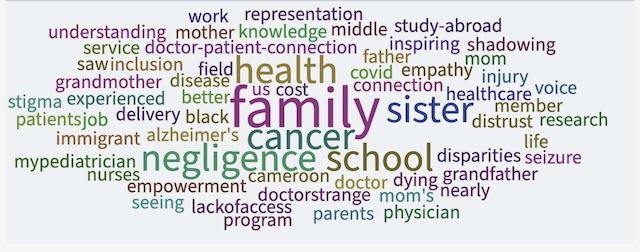
During the first section, facilitators described the purpose of the personal statement and encouraged students to share the attributes that best described them. During the “crafting your W.H.Y.” section, medical student facilitators asked participants to submit their first encounter with medicine on the Poll Everywhere (San Francisco, CA) online platform, accessed via Emory’s institutional license. The responses were displayed as a word cloud on the main screen to emphasize the diversity of participants’ experiences (Figure 1). Participants were asked to identify three people to proofread their personal statement, and facilitators encouraged willing participants to share the names of their selected proofreaders with the group.
Figure 1: Word cloud generated by participants’ responses when asked about their first encounter with health care
Facilitators asked participants to complete voluntary pre-and post-workshop surveys to assess changes in ability and confidence in accordance with the learning objectives (Appendix B and C, respectively). The surveys were disseminated through the Qualtrics platform (Provo, Utah), accessed through Emory’s institutional license. Using a 5-point Likert scale (1=strongly disagree, 5= strongly agree), the surveys measured participants’ perceived ability to articulate their personal story, format the statement appropriately, and proofread effectively.
The post-workshop survey additionally requested that participants review the workshop using a 5-point Likert scale. Participants rated whether the workshop addressed all their questions/concerns, the objectives were clearly communicated, the presenters were knowledgeable about the topic, they were able to interact with peers, and whether they would recommend the workshop to a peer. The post-workshop survey additionally included open-ended questions gauging participants’ lingering concerns about writing the personal statement and overall feedback for the workshop.
We de-identified the data and stored it in password secured databases. Only research team members had access to the data. All statistics were conducted using built-in Excel tools. We used paired t-tests to compare pre- and post-workshop survey responses for the participants who completed both surveys. The open-ended survey responses were analyzed qualitatively for salient themes. We used an alpha value of 0.05 to determine statistical significance. We also calculated the mean and standard deviation for post-survey results.
STUDY AND RESULTS
Twenty-three students attended the workshop and completed pre- and post-surveys to assess whether the workshop met the goals of the learning objectives. Of the 23 students who attended the workshop, 17 (74%) completed the pre-survey. All 23 participants completed the post-survey. We excluded six post-survey responses from the pre- versus post-survey statistical analysis since they did not have corresponding pre-survey responses. The Emory University Institutional Review Board deemed this study exempt.
Pre- versus post-survey results
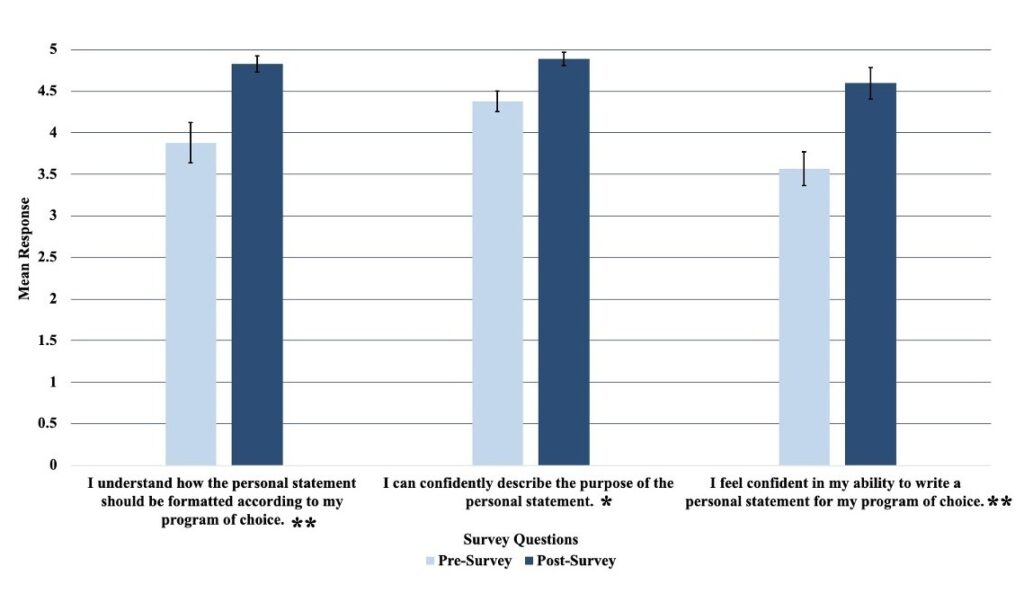
Students demonstrated an increase in their ability to understand how the personal statement should be formatted according to their program of choice (p<0.001) as well as an increase in their confidence to describe the purpose of the personal statement (p<0.05) and an increase in their confidence to write a personal statement for their program of choice (p <0.001) (Figure 2). Participants showed no significant change in their understanding of how their experiences help them connect with others or the importance of proofreading their personal statements. Similarly, there was no significant change in their confidence in incorporating their experiences into the statement or identifying three people to proofread it.
Figure 2: Changes in knowledge and confidence of participants who completed both pre- and post- surveys (n=17). *<0.05, **<0.001
Post-workshop survey results
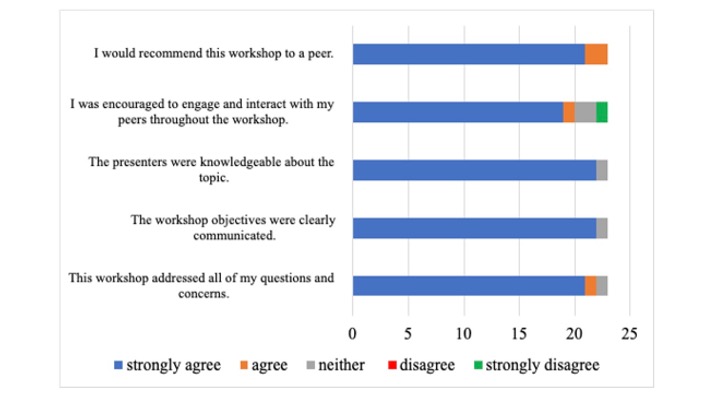
On the post-workshop survey, students reported that they would recommend the workshop to a peer (4.9±0.29), that the workshop addressed all their questions and concerns (4.9±0.46), that the workshop objectives were clearly communicated (4.9±0.42), that the presenters were knowledgeable about the topic (4.9±0.42), and that they were encouraged to engage and interact with their peers throughout the workshop (4.6±0.99) (Figure 3). Five participants reported having difficulty identifying salient attributes or experiences. Two participants were concerned about finding proofreaders. Another participant requested more peer engagement.
Figure 3: Distribution of post-survey workshop review responses for the participants who completed the post-survey (N=23)
DISCUSSION
In the absence of affirmative action, personal statements have become a critical opportunity for applicants to health professions education and training programs to convey their identity, lived experiences, and motivations. Despite its importance, few resources provide a structured framework to help applicants craft compelling and effective statements.
The purpose of this study was to evaluate the effectiveness of a novel workshop in providing pre-health applicants from disadvantaged backgrounds with the skills, knowledge, and confidence required to write effective personal statements, with the broader goal of contributing to the admission of more diverse cohorts of health professions students.
We found that workshop participants reported a significant increase in their knowledge of how the personal statement should be formatted, including the importance of minimizing typographical and grammatical errors to eliminate all modifiable barriers to an applicant effectively conveying their story. This is encouraging, as the quality of the personal statement is thought to demonstrate applicants’ professionalism, communication skills, and attention to detail (Residency Advisor, 2026). These skills are essential for healthcare professionals, and therefore, are crucial to demonstrate in an increasingly competitive application process, where even minor signs of indiscretion can significantly undermine the chances of success (Residency Advisor, 2026).
Participants also reported an increase in confidence to describe the purpose of the personal statement, an essential prerequisite to successful writing. Throughout the workshop, participants reflected on the experiences and personal attributes that not only drive their motivation to apply to their program of choice but also showcase their professional and academic achievements and understood the need to include those attributes in their statements.
In addition, participants demonstrated an increase in their confidence to write a personal statement for their program of choice. This workshop was designed for individuals interested in health professional programs, including medicine, physician assistant, anesthesiology assistant, genetic counseling, physical therapy, and public health. The difference in these careers begets slight differences in approach to the personal statement. Nevertheless, the participants demonstrated an overall increase in their confidence to write a personal statement, demonstrating the utility of this workshop across a multitude of health professional disciplines.
One limitation of this workshop is that it was created and presented by seven second-year medical students. Considering the inclusion of a wide variety of health professional programs, it may be beneficial to diversify the workshop presenters. Nevertheless, it is important to note that participants reported that presenters were knowledgeable about how to write personal statements.
Another limitation of this workshop was the limited peer interaction. One participant reported that they were not encouraged to engage and interact with their peers. In future iterations of this workshop, it would be beneficial to include more peer interaction by devoting time for participants to share their ideas and reflection in small groups. Previous studies demonstrate that peer interaction significantly improves learning outcomes (Tenenbaum et al., 2019). An additional limitation is that only one facilitator was present at the workshop in person while the other facilitators joined virtually. In person-engagement promotes increased participation which helps reinforce learning (Akpen et al., 2024).
CONCLUSION
A student-run workshop on personal statement writing was effective in increasing the preparedness of applicants from disadvantaged backgrounds to write their own statements and may contribute to the admission of diverse cohorts of healthcare professionals to address critical clinician shortages.
ACKNOWLEDGMENTS
The authors gratefully acknowledge Ifeyinwa Ogu’s contributions to the development and facilitation of the pilot workshop. The HealthPREP program receives funding from a HRSA Health Careers Opportunity Program grant.
Association of American Medical Colleges. (2025, January 9). New AAMC data on medical school applicants and enrollment in 2024. https://www.aamc.org/news/new-aamc-data-medical-school-applicants-and-enrollment-2024
Akpen, C. N., Asaolu, S., Atobatele, S., Okagbue, H., & Sampson, S. (2024). Impact of online learning on students’ performance and engagement: Systematic review. Discover Education, 3, 208. https://doi.org/10.1007/s4217-024-00253-0
Denton, M., Borrego, M., & Boklage, A. (2020). Community cultural wealth in science, technology, engineering, and mathematics education: A systematic review. Journal of Engineering Education, 109(3), 556–580. https://doi.org/10.1002/jee.20322
Emory University School of Medicine. (n.d.). Health professions readiness education program (HealthPREP). https://med.emory.edu/education/outreach-recruitment/healthprep/index.html
Florescu, N., Lin, A., Temucin, S., & Rae, L. (2025). Affirmative action repeal and racial and ethnic diversity in U.S. medical school admissions. JAMA Network Open, 8(10), 2535020. https://doi.org/10.1001/jamanetworkopen.2025.35020
Futela, D., Kumari, S., Malhotra, A., & Mathur, M. (2025). Creating a great application: CV, LORs and personal statement. Current Problems in Diagnostic Radiology, 54(6), 658–662. https://doi.org/10.1067/j.cpradiol.2025.10.002
Kurtyka, F. (2026). STEM gets personal: The medical school personal statement as developmental writing opportunity amid generative AI. Across the Disciplines, 22(3–4), 139–158. https://doi.org/10.37514/ATD-J.2026.22.3-4.03
Paris, J. H., & Kania, S. J. (Eds.). (2024). A comprehensive guide to graduate enrollment management: Advancing research and practice. Routledge.
Residency Advisor. (2026, January 5). Grammar, typos, and formatting errors that signal ‘careless resident’. https://residencyadvisor.com/resources/personal-statement-tips/grammar-typos-and-formatting-errors-that-signal-careless-resident
Salsberg, E., & Grover, A. (2006). Physician workforce shortages: Implications and issues for academic health centers and policymakers. Academic Medicine, 81(9), 782–787. https://doi.org/10.1097/00001888-200609000-00003
Tenenbaum, H. R., Winstone, N. E., Leman, P. J., & Avery, R. E. (2019). How effective is peer interaction in facilitating learning? A meta-analysis. Journal of Educational Psychology, 112(7), 1303–1319. https://doi.org/10.1037/edu0000436
University of Wisconsin–Madison, Center for Research on College-Workforce Transitions. (n.d.). Community cultural wealth. https://ccwt.wisc.edu/community-cultural-wealth
Witzburg, R. A., & Sondheimer, H. M. (2013). Holistic review: Shaping the medical profession one applicant at a time. New England Journal of Medicine, 368(17), 1565–1567. https://doi.org/10.1056/NEJMp1300411
Chiagoziem Ohamadike, BS
Medical student, Emory University School of Medicine
Vida Lugo, BA
Medical student, Emory University School of Medicine
Alexus Nicole Shaw, BS
Medical student, Emory University School of Medicine
Kensi Gray, BS
Medical student, Emory University School of Medicine
Alysha Victoria Shaw, BS
Medical student, Emory University School of Medicine
Cindy Emenalo, BS
Medical student, Emory University School of Medicine
Vanessa Caridad Fleites, PhD
Medical student, Emory University School of Medicine
Published 9/3/26